In creating paintings of my homeland, Wales, it struck me how much of the history of the country and its people is so closely tied to the coal mining industry. For example, the growth in the size and prosperity of Cardiff could be clearly linked to the surge in coal exports through its port. That coal came from the mines located just North of Cardiff in towns like Merthyr Tydfil and the nearby village of Aberfan.
Despite the jobs and prosperity, the coal brought a terrible price in human suffering. On the 21st of October, 1966, one of the slag heaps (created from all the waste generated during the extraction process) just above the town of Aberfan gave way and the debris slid down into the town. 28 adults and 116 children were killed. The children were located in the Pantglas junior school in the path of the debris avalanche.
So 2016 marks the 50th anniversary of Aberfan. I was only two years old at the time - but I do remember the terrible impact on the community, not far from my home. I remember my dad taking me on a trip through the valleys one day, and he showed me the location.
To help me remember and to pause to consider what is lost, I tried to capture the disaster in a small watercolor painting. Instead of my typical precision using photographs, this was actually a painting that was very spontaneous and drawn from my memories of seeing the pictures that have found their way onto the Internet. So forgive the fact that details are blurry and probably very inaccurate. But this is what popped into my head. Ironically, this was painted in just a few minutes as I took an opportunity to sit outside on an unusually warm spring day in Dayton, Ohio. Such a contrast - from a spring day full of life and sunshine to remember a much darker day in the fall of 1966. But remember we must.
More information can be found at https://en.wikipedia.org/wiki/Aberfan_disaster and http://www.nuffield.ox.ac.uk/politics/aberfan/home.htm
Friday, March 18, 2016
Friday, March 11, 2016
Watercolor Painting: Tribute to Ronald White Jr., 2016
This simple portrait was created from a small passport-sized photograph of Ronald White Jr. (Dayton, Ohio), who was tragically killed in 2010 through gun violence (see http://www.legacy.com/obituaries/dayton/obituary.aspx?pid=144597741). I wanted to thank Ronald White Sr. for the opportunity to honor his son's life and allow me to expand my painting skills by making this tribute.
The painting was made on Canson Montval board with three Winsor & Newton colors:
- French ultramarine
- Permanent rose
- Burnt sienna
Sunday, January 24, 2016
Small Watercolor Paintings of 2015
The largest paintings I made during 2015 were described in separate postings. But here are some small scale paintings and sketches from the same year...
This small painting (5 x 8 inches) is drawn from the life of my grandfather (on my Mothers side), Edward Woolven. As a young man he worked as a driver of steam wagons operating out of a quarry near our home... in Wenvoe, Wales. As a child I was impressed with the steam wagons, traction engines and railroad steam engines that he would show us at fairs held in Cardiff. This watercolor painting was made from a photograph shown in the book "Ely Voices" by Nigel Billingham and Stephen Jones, that contained contributions from my grandfather as he described Ely from the early 1900's.
To experiment with some watercolor pencils, I created the following copy of JMW Turner's "Dunstanborough Castle, Northumberland". This is was my first use of watercolor pencils. (5 x 8 inches).
These two small paintings (5 x 8 inches) were made using travel magazine photographs (and in-person inspirations) from a visit to Washington DC.
This was a really tiny painting (3 x 3 inches) made during a trip to Nashville. It shows the replica of the Parthenon in Nashville's Centennial Park.
A few other miscellaneous paintings (~3 x ~3 inches).
Materials: Sketch books containing Canson Montval paper or Arches cold press; Winsor & Newton or Cotman tubes/pan-based watercolors; Faber-Castell Albrecht Durer watercolor pencils and Sakura Pigma Micron pens.
This small painting (5 x 8 inches) is drawn from the life of my grandfather (on my Mothers side), Edward Woolven. As a young man he worked as a driver of steam wagons operating out of a quarry near our home... in Wenvoe, Wales. As a child I was impressed with the steam wagons, traction engines and railroad steam engines that he would show us at fairs held in Cardiff. This watercolor painting was made from a photograph shown in the book "Ely Voices" by Nigel Billingham and Stephen Jones, that contained contributions from my grandfather as he described Ely from the early 1900's.
To experiment with some watercolor pencils, I created the following copy of JMW Turner's "Dunstanborough Castle, Northumberland". This is was my first use of watercolor pencils. (5 x 8 inches).
These two small paintings (5 x 8 inches) were made using travel magazine photographs (and in-person inspirations) from a visit to Washington DC.
This was a really tiny painting (3 x 3 inches) made during a trip to Nashville. It shows the replica of the Parthenon in Nashville's Centennial Park.
A few other miscellaneous paintings (~3 x ~3 inches).
Materials: Sketch books containing Canson Montval paper or Arches cold press; Winsor & Newton or Cotman tubes/pan-based watercolors; Faber-Castell Albrecht Durer watercolor pencils and Sakura Pigma Micron pens.
Friday, August 7, 2015
Watercolor Painting: Jerry Timbrook 2015
Jerry Timbrook was a member of the E-Learning Lab at the University of Dayton for seven years up until the end of summer 2015, when he moved to Nebraska to attend the PhD program in survey design at the University of Nebraska. As a parting gift to say "thank you" for his excellent work at the University of Dayton and to recognize his interest in the Dr. Who TV series, I created this watercolor painting in the style of a graphic novel (or I would call a comic).
The basic story may not make any sense to anyone but Jerry since it references the things we remember him for. We wish Jerry the very best for success in his PhD coursework and research.
Using my standard method (see below), the picture began as a composite layout within PowerPoint. The ~8x10 composite image was reversed and printed, copied by hand with a pencil onto tracing paper and then transferred right-side-up onto Canson Montval cold press watercolor paper. The pencil work was reinforced with Pigma Micron black ink pens. The colors were all pan-based Winsor & Newton.
The basic story may not make any sense to anyone but Jerry since it references the things we remember him for. We wish Jerry the very best for success in his PhD coursework and research.
Using my standard method (see below), the picture began as a composite layout within PowerPoint. The ~8x10 composite image was reversed and printed, copied by hand with a pencil onto tracing paper and then transferred right-side-up onto Canson Montval cold press watercolor paper. The pencil work was reinforced with Pigma Micron black ink pens. The colors were all pan-based Winsor & Newton.
Friday, July 3, 2015
Watercolor Painting: Wright Brothers, 2015
In an earlier post, I wrote about my desire to create three paintings that celebrate famous Ohio aviators. The paintings are coming out of sequence, but I have just finished the Wright Brothers. So once all three are completed this will be the first in the historical sequence. I should say up front that I am no relation to the Wright brothers - that I know of. But I have always been fascinated by their journey to achieve powered flight. Living in Dayton, Ohio, I am especially privileged to marvel at the incredible story of their perseverance to build the worlds first heavier-than-air, powered aircraft.
Although their gliders and first powered aircraft (1903 Flyer I) took to the air at Kitty Hawk, North Carolina, the brothers worked hard to test their subsequent designs closer to home in Dayton, Ohio. A few miles from the city center, they began testing their next aircraft... Flyer II (1904) and Flyer III (1905). It is this third plane that I show in the painting, because of its significance as the first truly controllable and recoverable aircraft. The original vehicle is now on display at Carillon Park in Dayton, not far from where I work at the University of Dayton.
As with my John Glenn painting, this is both a landscape and a portrait. For all three paintings in this sequence, I have tried to showcase the changing horizon in each image... in other words the aviators helped us see "over" the horizon. Consequently I tried to paint a landscape for this painting that looked as though it was seen through a fish-eye lens. This creates a uniform look across all three paintings. An important theme linking the three paintings is that Ohio is clearly visible as the backdrop and home of these pioneering aviators.
Let me explain the details of this painting... On the left side of the picture is the older and slightly taller Wilbur Wright. On his right is Orville Wright. In the background, I have tried to capture a view of the Flyer III as it looked in 1905, making one of the flights during the summer or early fall, over Huffman Prairie. Although the brothers both flew their aircraft, during this flight it is Orville at the controls with Wilbur on the ground with the flag. The view is looking out across the Ohio countryside towards the North. In the distance on the left, you can see the city of Dayton. I could not help but make it look somewhat industrial with some air pollution, because it was a very vibrant manufacturing center. Radiating away from Dayton towards the East, you can see the railroad that carried freight to Columbus, Cleveland and onward. You can also see the urban rail carrying a light passenger/freight car to nearby cities. Wilbur and Orville used this rail service to travel to and from their home and bicycle shop in Dayton. They would bring their supplies and assemble the airplanes in the wooden shed they constructed. The rail stop was called Simm Station, and can be seen in this picture. I have estimated the placement of the shed, but it does give you the sense that they wanted to be some distance from the interurban railway. At various times during this period of time, 1905, the Wright Brothers would be joined by a few family or friends - but especially by Charlie Taylor (next to the tool box that can be seen today at Carillon Park). He was the engineer/mechanic that created the engine that powered the aircraft. This picture shows one of the successful flights made by Flyer III in the presence of a few invited individuals. The general public have yet to catch on to what was happening... although by showing the paused interurban, you get the sense that members of the public are wondering what on Earth they are seeing (or what off-Earth they are seeing). Importantly, I did want to show that this flight was witnessed by Katherine, the sister of Wilbur and Orville, who took a great interest in the work of the brothers and did so much to support their efforts. Joining Katherine is Bishop Milton Wright, the father. I am also placing one of the other two brothers... Lorin, in the distance with a camera. There are a few other guests in the distance. Because the brothers flew multiple flights on different dates in 1905, I am taking the liberty of assembling this specific scene with these individuals, even though they may have been present on different dates.
I added a few embellishments... artistic license if you will. In the trees on the right you can just make out two "spies" sent by Samuel Langley. I also placed some ominous storms on the horizon to indicate trouble ahead. This could mean the patent battles that ensued in the coming years. It could also mean the beginning of World War I, which provided a terrifying use for this new invention of flight. Somewhat below the Flyer III, you can see a dove. I know that Wilbur and Orville were looking to the government to find good uses for their airplane, but I have not seen evidence that they imagined their invention being turned into a weapon, and generally envisioned peaceful applications. With all these serious elements to the painting, I also added a little bit of fun. One of the observers is a boy, seen with outstretched arms... the first child to imitate a plane, and accidentally providing one of the first clues to a newspaper reporter that indeed something was "up" with the rumors about the Wright brothers. Lastly I could not help but to add a Wright brothers-built bicycle resting against their shed. This signifies the origin of the Wright brothers technical prowess, hints at the passing of their interest in this business and more importantly documents several forms of contemporary transportation in this picture that are overshadowed by the new invention of the airplane. Automobiles are missing from this scene although they were starting to appear on the streets at this time.
As an aside, I have represented the 1905 Flyer III without the "blinkers" that can be found on the forward elevator in the Carillon Park restored aircraft. I did this because the original photographs (especially flight 46 when Katherine and Milton were present) do not show the blinkers on the plane at this time.
The colors I used for this painting (see below) were all Winsor and Newton or Cotman watercolors. These were mostly tube-based with some pans. The paper was Arches cold press artboard, 20 by 30 inches. No masking fluid was used for this painting even though I was sorely tempted.
I am also showing here the various steps leading to the finished work. Tracing paper was used to transfer images from photographs to the artboard. Google Earth was used to estimate the various geographic features and placement of Huffman Prairie.
Although their gliders and first powered aircraft (1903 Flyer I) took to the air at Kitty Hawk, North Carolina, the brothers worked hard to test their subsequent designs closer to home in Dayton, Ohio. A few miles from the city center, they began testing their next aircraft... Flyer II (1904) and Flyer III (1905). It is this third plane that I show in the painting, because of its significance as the first truly controllable and recoverable aircraft. The original vehicle is now on display at Carillon Park in Dayton, not far from where I work at the University of Dayton.
As with my John Glenn painting, this is both a landscape and a portrait. For all three paintings in this sequence, I have tried to showcase the changing horizon in each image... in other words the aviators helped us see "over" the horizon. Consequently I tried to paint a landscape for this painting that looked as though it was seen through a fish-eye lens. This creates a uniform look across all three paintings. An important theme linking the three paintings is that Ohio is clearly visible as the backdrop and home of these pioneering aviators.
Let me explain the details of this painting... On the left side of the picture is the older and slightly taller Wilbur Wright. On his right is Orville Wright. In the background, I have tried to capture a view of the Flyer III as it looked in 1905, making one of the flights during the summer or early fall, over Huffman Prairie. Although the brothers both flew their aircraft, during this flight it is Orville at the controls with Wilbur on the ground with the flag. The view is looking out across the Ohio countryside towards the North. In the distance on the left, you can see the city of Dayton. I could not help but make it look somewhat industrial with some air pollution, because it was a very vibrant manufacturing center. Radiating away from Dayton towards the East, you can see the railroad that carried freight to Columbus, Cleveland and onward. You can also see the urban rail carrying a light passenger/freight car to nearby cities. Wilbur and Orville used this rail service to travel to and from their home and bicycle shop in Dayton. They would bring their supplies and assemble the airplanes in the wooden shed they constructed. The rail stop was called Simm Station, and can be seen in this picture. I have estimated the placement of the shed, but it does give you the sense that they wanted to be some distance from the interurban railway. At various times during this period of time, 1905, the Wright Brothers would be joined by a few family or friends - but especially by Charlie Taylor (next to the tool box that can be seen today at Carillon Park). He was the engineer/mechanic that created the engine that powered the aircraft. This picture shows one of the successful flights made by Flyer III in the presence of a few invited individuals. The general public have yet to catch on to what was happening... although by showing the paused interurban, you get the sense that members of the public are wondering what on Earth they are seeing (or what off-Earth they are seeing). Importantly, I did want to show that this flight was witnessed by Katherine, the sister of Wilbur and Orville, who took a great interest in the work of the brothers and did so much to support their efforts. Joining Katherine is Bishop Milton Wright, the father. I am also placing one of the other two brothers... Lorin, in the distance with a camera. There are a few other guests in the distance. Because the brothers flew multiple flights on different dates in 1905, I am taking the liberty of assembling this specific scene with these individuals, even though they may have been present on different dates.
I added a few embellishments... artistic license if you will. In the trees on the right you can just make out two "spies" sent by Samuel Langley. I also placed some ominous storms on the horizon to indicate trouble ahead. This could mean the patent battles that ensued in the coming years. It could also mean the beginning of World War I, which provided a terrifying use for this new invention of flight. Somewhat below the Flyer III, you can see a dove. I know that Wilbur and Orville were looking to the government to find good uses for their airplane, but I have not seen evidence that they imagined their invention being turned into a weapon, and generally envisioned peaceful applications. With all these serious elements to the painting, I also added a little bit of fun. One of the observers is a boy, seen with outstretched arms... the first child to imitate a plane, and accidentally providing one of the first clues to a newspaper reporter that indeed something was "up" with the rumors about the Wright brothers. Lastly I could not help but to add a Wright brothers-built bicycle resting against their shed. This signifies the origin of the Wright brothers technical prowess, hints at the passing of their interest in this business and more importantly documents several forms of contemporary transportation in this picture that are overshadowed by the new invention of the airplane. Automobiles are missing from this scene although they were starting to appear on the streets at this time.
As an aside, I have represented the 1905 Flyer III without the "blinkers" that can be found on the forward elevator in the Carillon Park restored aircraft. I did this because the original photographs (especially flight 46 when Katherine and Milton were present) do not show the blinkers on the plane at this time.
The colors I used for this painting (see below) were all Winsor and Newton or Cotman watercolors. These were mostly tube-based with some pans. The paper was Arches cold press artboard, 20 by 30 inches. No masking fluid was used for this painting even though I was sorely tempted.
- French ultramarine
- Permanent rose
- Permanent sap green
- Hookers green
- Vandyke brown
- Paynes gray
- New gamboge
- Raw sienna
- Burnt sienna
- Cobalt blue
- Purple lake
- Cadmium yellow hue
- Yellow ochre
- Zinc white (gouache)
I am also showing here the various steps leading to the finished work. Tracing paper was used to transfer images from photographs to the artboard. Google Earth was used to estimate the various geographic features and placement of Huffman Prairie.
Monday, February 23, 2015
Next Generation Learning Spaces
The following slides are from my presentation at the CLN "Next Generation Learning Spaces" Conference in Nashville, TN, February 2015.
Tuesday, February 10, 2015
Watercolor Painting: John Glenn, 2015
I have always had a deep interest in the history of space flight, including the very earliest flights made by the pioneering group of astronauts, the "Mercury 7" - including John Glenn. So I have created a painting that was a culmination of my research of John Glenn's flight in his capsule, Friendship 7 (so named because of the seven astronauts in this first group).
I tried to show the view of Friendship 7 as it would have appeared at the end of its last orbit, during the beginning of the re-entry into the atmosphere. Due to the possibility that the heat shield was not firmly attached, the flight controllers instructed John to keep the retro rocket pack attached to the underside of the capsule. This made for what was already a risky venture even more of a dramatic and dangerous flight. The retro rocket pack is shown at the bottom of the spacecraft as it began melting away because of the heat of re-entry.
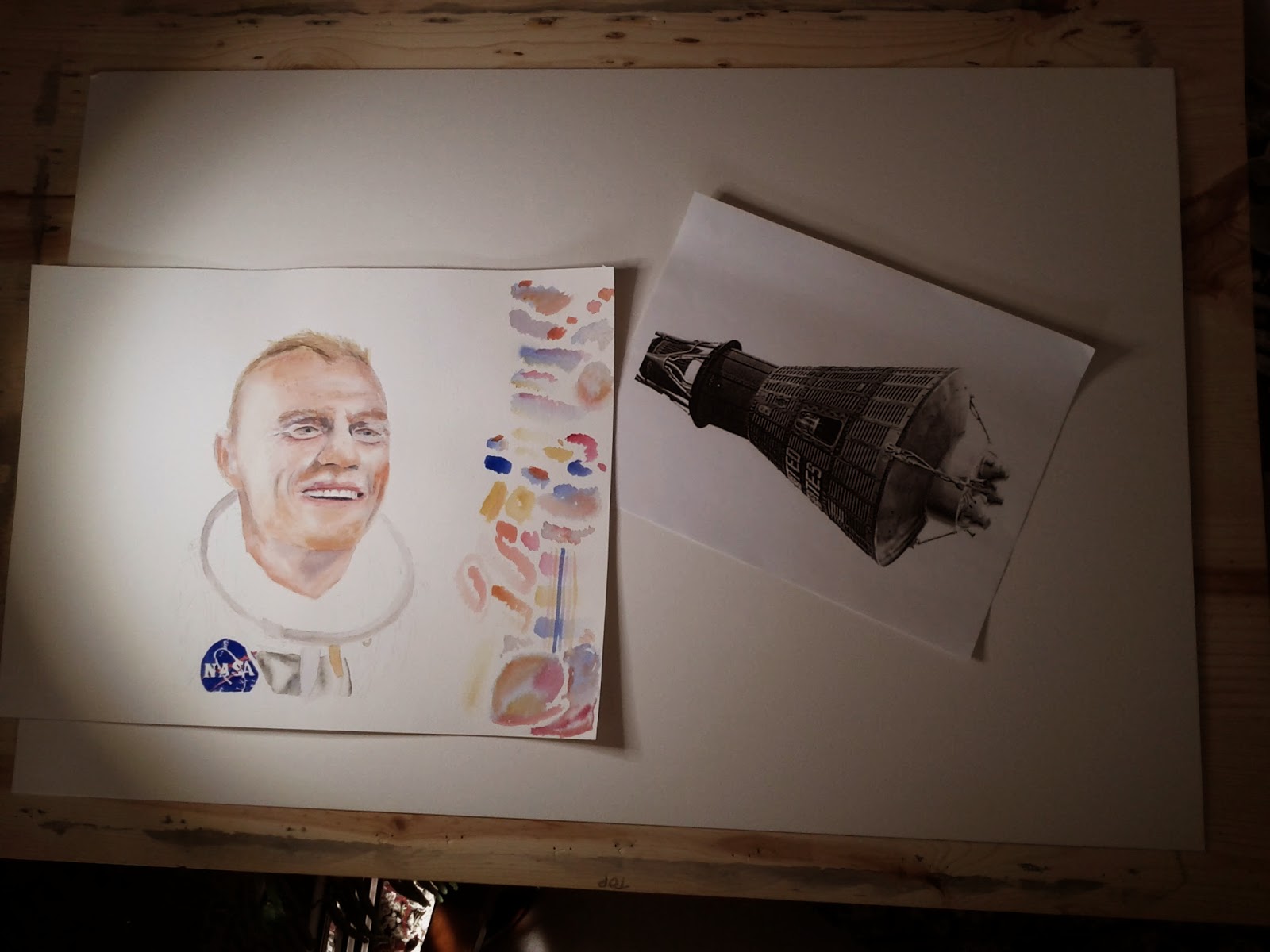
In the picture, I tried to represent the Mercury 7 by the placement of the Big Dipper constellation (Ursa Major) on the upper left. In reality, I think the constellation should have appeared on the right at the time represented by the image and tipped on its side... so I am taking artistic license in moving the stars! The placement of the Friendship 7 capsule is fairly accurate, since the "splashdown" occurred in the Atlantic. I also tried to lineup this picture to have the spacecraft seemingly fly over Ohio - John Glenn's birthplace.
This picture was completed during the Christmas and New Year holiday period between 2014 and 2015, but I had been researching the possibility of completing a portrait of John Glenn since early 2014. My goal is to have this picture be one in a series recognizing Ohio fliers. If I can finish the other pictures, the John Glenn portrait is number 2 of 3.
The painting was made on 20 by 30 inch Arches art board with a cold press finish. The Winsor and Newton paints (almost completely tube-based) included:
I tried to show the view of Friendship 7 as it would have appeared at the end of its last orbit, during the beginning of the re-entry into the atmosphere. Due to the possibility that the heat shield was not firmly attached, the flight controllers instructed John to keep the retro rocket pack attached to the underside of the capsule. This made for what was already a risky venture even more of a dramatic and dangerous flight. The retro rocket pack is shown at the bottom of the spacecraft as it began melting away because of the heat of re-entry.
In the picture, I tried to represent the Mercury 7 by the placement of the Big Dipper constellation (Ursa Major) on the upper left. In reality, I think the constellation should have appeared on the right at the time represented by the image and tipped on its side... so I am taking artistic license in moving the stars! The placement of the Friendship 7 capsule is fairly accurate, since the "splashdown" occurred in the Atlantic. I also tried to lineup this picture to have the spacecraft seemingly fly over Ohio - John Glenn's birthplace.
This picture was completed during the Christmas and New Year holiday period between 2014 and 2015, but I had been researching the possibility of completing a portrait of John Glenn since early 2014. My goal is to have this picture be one in a series recognizing Ohio fliers. If I can finish the other pictures, the John Glenn portrait is number 2 of 3.
The painting was made on 20 by 30 inch Arches art board with a cold press finish. The Winsor and Newton paints (almost completely tube-based) included:
- French ultramarine
- Permanent rose
- Raw sienna
- Burnt sienna
- Zinc white (Gouache)
- Hookers green
- Paynes grey
- Lamp black
- Manganese blue
- Cobalt blue
- Cerulean blue
- Cadmium red
- Davys grey
- Cadmium orange
- New gamboge
- Emerald
Subscribe to:
Posts (Atom)


